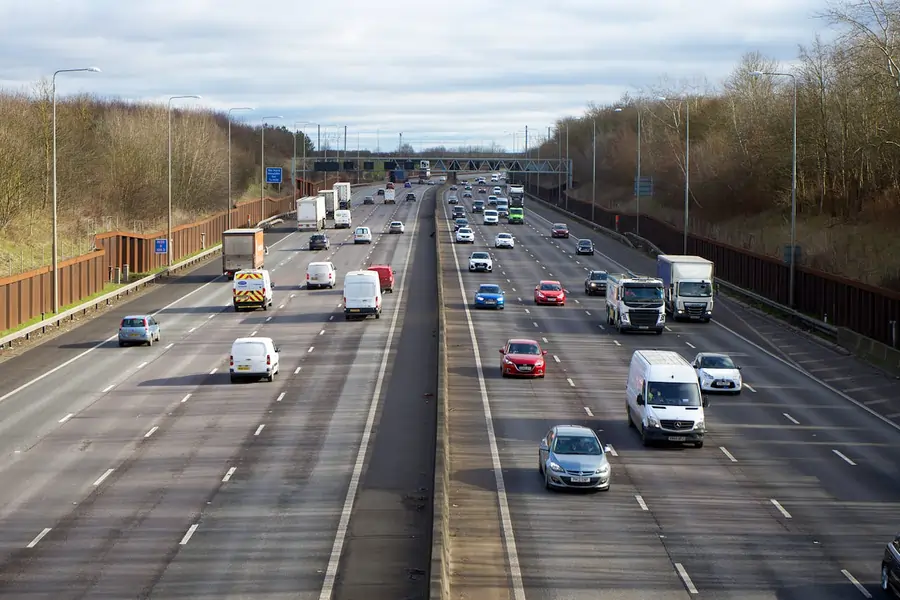
There’s a unique thrill the first time you see the iconic blue signs with their crisp white lettering. For years, they represented a part of driving you could only experience after you’d passed your test. That all changed. Now, the world of motorway driving is open to learners, and it’s one of the most valuable experiences you can get before going solo.
But let’s be honest, the thought of joining a three-lane road where traffic moves at 70mph can be intimidating. It’s a huge step up from your local town centre or even a fast dual carriageway. This isn’t just about going faster; it’s about a completely new set of rules, signs, and skills.
Consider this your comprehensive map to navigating your first experience of motorway driving. We’ll break down the laws, demystify the technology, and give you the practical skills you need to merge with confidence.
The Green Light for Learners: Your Legal Guide to Motorway Driving
For decades, motorways were off-limits to anyone with L-plates. The law changed back in June 2018, and it was a game-changer for driver education in the UK. The government recognised that throwing newly qualified drivers onto a motorway without any prior experience was a recipe for anxiety and potential danger.
However, you can’t just decide to have a go on the M25 on a whim. The rules are very specific and designed entirely around your safety.
To practice motorway driving as a learner, you must meet two crucial conditions:
- You must be accompanied by an Approved Driving Instructor (ADI). Your well-meaning parent or friend cannot legally take you for a motorway lesson.
- The car you are driving must be fitted with dual controls. This gives your instructor the ability to intervene if necessary, providing a vital safety net.
It’s important to understand that these motorway lessons are voluntary. They are not a mandatory part of the learning curriculum, and you won’t be tested on motorway driving during your practical test. Your instructor will only suggest a motorway lesson when they feel you have developed the necessary skills and confidence in other driving situations.
Think of it as postgraduate learning. You’ve mastered the core subjects on A-roads and B-roads; now it’s time for an advanced course that will make you a safer, more competent driver for life.
Motorways vs. Dual Carriageways: Key Differences to Master
Many learners think a motorway is just a dual carriageway without a speed limit sticker. While they share some characteristics, like two separated carriageways, they are fundamentally different environments. Understanding these distinctions is the first step toward mastering high-speed driving.
Speed, Structure, and Signs
The most obvious difference is the national speed limit, which is 70mph for cars on a motorway, opposed to varying limits on dual carriageways. But the structure is the bigger factor. Motorways are designed for an uninterrupted flow of traffic.
You won’t find any roundabouts, traffic lights, or sharp junctions for minor roads. All traffic joins and leaves via dedicated slip roads. Traditionally, motorways also feature a hard shoulder on the far left for emergencies, something most dual carriageways lack.
The signage is also a major step up. On a motorway, you need to be looking further ahead and reading signs much earlier. Exits are typically signposted at one mile, then half a mile, and then with countdown markers (three bars, two bars, one bar) to the slip road.
Decoding Smart Motorways
One of the biggest evolutions in UK road networks is the roll-out of “Smart Motorways”. These are sections of motorway that use advanced technology to manage traffic flow and reduce congestion. As a driver in 2026, you will inevitably encounter them.
Instead of fixed signs, Smart Motorways use large overhead gantries with electronic displays. These can change in real-time to control the driving conditions. Key things you’ll see are:
- Variable Speed Limits: A number in a red circle on the gantry is a mandatory speed limit, not an advisory one. These are used to smooth out traffic flow and prevent “stop-start” jams. Breaking these limits is illegal.
- Lane Closures: A bold Red X on a gantry means the lane below is closed. You must move out of a lane with a Red X as soon as it is safe to do so. Ignoring it is extremely dangerous and illegal, as there could be a stranded vehicle or road workers ahead.
- Information Displays: The gantries can also display messages like “Queue ahead” or “Fog”, giving you advance warning of hazards.
Understanding and obeying these gantry signs is a non-negotiable part of modern motorway driving. They are the digital eyes and ears of the road network, working to keep you safe.
Emergency Refuges vs. The Hard Shoulder
On a traditional motorway, the hard shoulder is your lifeline in a breakdown or emergency. You should only ever stop there for a genuine emergency, never for a non-urgent reason like making a phone call.
Many Smart Motorways, however, are “All Lane Running” (ALR), which means the old hard shoulder is now used as a permanent live traffic lane. So where do you go if you get into trouble?
This is where Emergency Refuge Areas (ERAs) come in. These are orange-painted lay-bys set back from the main carriageway, equipped with an emergency telephone. They are spaced roughly every 1.5 miles. If you experience a problem on an ALR motorway, you must try to coast to the next ERA. Never just stop in a live lane unless it is a catastrophic failure and completely unavoidable.
Mastering the Motorway: Essential Skills for High-Speed Confidence
With the theory covered, it’s time to focus on the practical skills that make for safe and smooth motorway driving. Your instructor will guide you through these manoeuvres, but knowing the process in advance gives you a huge advantage.
The Art of the Merge: Joining from a Slip Road
Joining a motorway is often the most nerve-wracking part for a first-timer. The slip road is your runway; its purpose is to get your vehicle up to the same speed as the traffic in the left-hand lane.
As you move along the slip road, use your accelerator decisively. This is not the time for timid driving. Check your mirrors constantly and identify a safe gap in the traffic. Your right-hand indicator should be on to show your intention to merge.
As you near the end of the slip road, make a final blind spot check over your right shoulder. Adjust your speed to match the gap you’ve chosen and then merge smoothly and confidently. The golden rule is do not stop at the end of the slip road unless traffic is at a complete standstill. Stopping makes it incredibly difficult and dangerous to join the fast-moving traffic.
Lane Discipline: The Unwritten Rule of the Road
Proper lane discipline is the cornerstone of safe and efficient motorway driving. The rule is simple: you should always stay in the leftmost available lane unless you are overtaking other vehicles.
The middle and right-hand lanes are for overtaking only. Once you have safely passed a vehicle (or a stream of vehicles), you must move back to the left lane as soon as it is safe. Driving unnecessarily in the middle or right-hand lanes is known as “middle-lane hogging.”
It’s not just bad manners; it’s a finable offence that causes congestion and forces other drivers to weave between lanes to overtake. Good lane discipline keeps the entire motorway flowing smoothly and predictably for everyone.
Overtaking with Precision and Safety
Overtaking is a fundamental part of motorway driving. To do it safely, you must use the tried-and-tested MSM (Mirror-Signal-Manoeuvre) routine, but with heightened awareness due to the high speeds.
The process should be methodical:
- Mirrors: Check your interior and right-wing mirrors to assess the speed and position of traffic behind you.
- Signal: Indicate your intention to move into the lane to your right.
- Blind Spot: Make a quick but essential check over your right shoulder to ensure no one is hiding in your blind spot.
- Manoeuvre: If it’s all clear, move smoothly into the overtaking lane. Accelerate past the vehicle(s) you are overtaking.
- Return: Once you can see the entire front of the car you have passed in your interior mirror, check your left-wing mirror, signal left, and move safely back into the left lane.
Remember to leave plenty of space. Everything happens much faster at 70mph, so your safety margins need to be much larger than on a 30mph road.
From L-Plates to Fast Lanes: How the Learners Guide Prepares You
Tackling your first motorway lesson is the culmination of all the skills you’ve been working on. The ability to handle high speeds doesn’t just appear; it’s built upon a solid foundation of car control, hazard perception, and forward planning.
This is where our comprehensive curriculum truly shines. The DVSA-approved materials and expert tuition you receive when you sign up with us are designed to create well-rounded, confident drivers, not just people who can pass a test. Our comprehensive Learners Guide covers everything from basic car control to advanced hazard perception, giving you the mental toolkit needed for complex environments.
The same observation skills you use to spot a pedestrian on a residential street are simply adapted and projected further ahead for motorway driving. The smooth clutch control you master in traffic becomes the precise acceleration needed to merge onto a slip road. What we teach you prepares you for every road, including the fastest ones in the country.
Your first motorway driving experience marks a significant milestone in your journey. It’s the moment you transition from a learner navigating local roads to a driver capable of tackling long-distance journeys. It’s challenging, yes, but with the right preparation and mindset, it’s also incredibly rewarding. Embrace the challenge, trust in your skills, and enjoy the freedom of the open road.