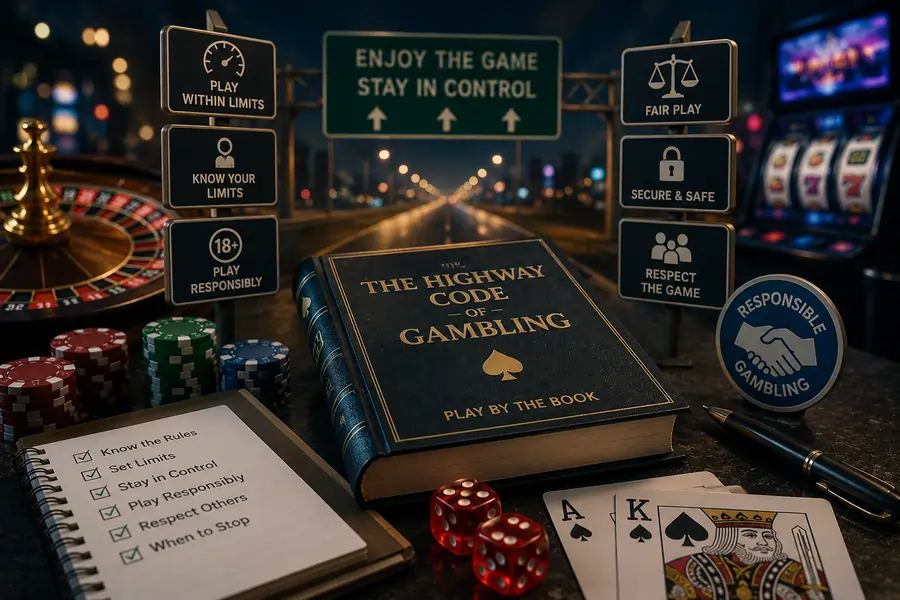
Nobody questions why the Highway Code exists. Every learner driver in the UK accepts, more or less cheerfully, that the road has rules, that the rules exist for good reasons and that following them is what separates a safe driver from a statistic. Speed limits are not there to spoil your fun; they are there because physics does not negotiate. Stopping distances, mirror checks, giving way at junctions: each rule encodes a lesson someone once learned the hard way, so that the rest of us do not have to. Now here is the interesting thought: gambling has a highway code too. It is less official, less examined and printed in no government booklet, but it exists, and the players who follow it enjoy the ride while the players who ignore it end up in the metaphorical ditch. In this article we take the rules of the road and translate them, one by one, into the rules of the game.
Rule one: know your speed limit before you set off
The first thing every learner absorbs is that different roads have different limits, and that the limit is decided before you arrive, not negotiated in the moment. Thirty through town, sixty on the single carriageway, seventy on the motorway. You do not glance at an empty high street and decide that today it feels like a fifty.
The gambling equivalent is the budget, and it works on exactly the same principle: it is set before the session starts, not adjusted mid-drive because conditions feel good. Decide what an evening’s entertainment is worth to you, in money and in time, before you log in. Then treat that number the way you treat a speed limit: as a fixed feature of the landscape rather than a suggestion. The driver who speeds because the road looks clear and the player who exceeds the budget because the session feels lucky are making the same error, mistaking a good moment for a change in the underlying rules.
Rule two: stopping distance is everything
The Highway Code devotes serious attention to stopping distances, because the single most dangerous illusion in driving is the belief that you can stop instantly when something goes wrong. You cannot. At speed, your thinking distance and braking distance stretch far beyond intuition, which is why safe drivers build in margin long before they need it.
Gambling has stopping distances too, and wise players respect them. The moment to stop is not the moment things go wrong; by then, emotion has lengthened your braking distance considerably. A losing streak generates frustration, and frustration wants one more spin the way a tailgating driver wants one more mile an hour. The practical fix mirrors defensive driving: build in your stopping points early. Set a loss limit and a time limit at the start of the session, and honour them automatically, the way you brake for a red light without debating it. Stopping on schedule when you would rather continue is the gambling equivalent of maintaining a safe following distance: invisible when it works, invaluable when it matters.
Rule three: check your mirrors, know what is around you
Mirror, signal, manoeuvre: the rhythm is drilled into every learner because awareness is the foundation of every good decision on the road. A driver who knows what is behind and beside them makes calm, informed choices; a driver who does not is simply guessing at seventy miles an hour.
For the player, awareness means knowing the facts of the games you play. Every casino game has published numbers: the return to player percentage, the volatility, the rules and terms that govern bonuses and withdrawals. Playing without checking them is driving without mirrors. Before you play any game at a platform such as spiidicasino.io/en/, take the thirty seconds required to open the game information panel, read the RTP and understand the bonus terms attached to any promotion you accept. It is the players’ version of the walk-around check before a long journey: brief, unglamorous and the mark of someone who takes the activity seriously enough to do it properly.
Rule four: never drive tired, angry or under the influence
The Highway Code is blunt about impairment. Alcohol, exhaustion and strong emotion all degrade judgement, slow reactions and turn a competent driver into a hazard, which is why the rules around them are absolute rather than advisory. No experienced driver considers a couple of drinks and a motorway a reasonable combination.
The same discipline applies at the tables, for the same neurological reasons. Playing while upset, exhausted or after drinking degrades exactly the faculties that responsible play depends on: impulse control, arithmetic, the ability to stop on schedule. Tilt, the gambling term for emotion-driven play, is impairment by another name. The rule translates cleanly: if you would not trust yourself to drive in your current state, do not trust yourself to gamble in it either. The games will still be there tomorrow, and unlike the motorway, nothing about them requires you to be there tonight.
Rule five: learn from a proper instructor, not from guesswork
Nobody sensible learns to drive by trial and error on the A road. Structured learning exists because it works: a good instructor sequences the skills, corrects mistakes before they become habits and prepares you for situations you have not yet met. The entire ecosystem of driving education, from professional lessons to the theory test preparation covered comprehensively by the learners guide, exists on the principle that knowledge acquired before you need it is worth far more than knowledge acquired in the moment of crisis.
Gambling rewards the same approach, though far fewer people take it. Learning blackjack basic strategy before you sit down, understanding how wagering requirements work before you accept a bonus, reading how volatility shapes a slot session before you choose one: this is the player’s driving lesson, and it changes the entire experience. The informed player is not guaranteed to win, any more than a well-taught driver is guaranteed never to encounter ice. But they make better decisions, avoid the predictable mistakes and get considerably more enjoyment per pound than the player who learns everything the expensive way.
Rule six: respect the authorities that keep the road safe
Behind the Highway Code stands an infrastructure most drivers rarely think about: the DVSA setting standards, MOT tests keeping unsafe vehicles off the road, licensing ensuring that everyone driving has demonstrated basic competence. The system is occasionally irritating and entirely essential, because roads without rules are demonstrably lethal.
Gambling has its own regulatory infrastructure, and using it is the simplest safety decision a player can make. In Great Britain, the Gambling Commission licenses operators, enforces standards on fairness and player protection and requires the safer gambling tools, deposit limits, time-outs and self-exclusion, that every licensed platform must provide. Playing only with properly licensed operators is the gambling equivalent of driving a car with a valid MOT: it does not eliminate every risk, but it guarantees a baseline of safety that unlicensed alternatives simply do not offer. And if play ever stops feeling like entertainment, free and confidential help is available through GamCare, whose advisers support anyone in the UK with concerns about their own gambling or someone else’s.
Conclusion: rules are what make the journey enjoyable
The deepest lesson of the Highway Code is one that learner drivers only appreciate later: the rules are not the enemy of the journey but the thing that makes journeys possible at all. Limits, checks, margins and discipline are precisely what allow millions of people to travel at speed, every day, and arrive intact. The highway code of gambling works identically. Set your limits before you start, respect your stopping distances, know your games, never play impaired, learn before you wager and stay inside the licensed system. Follow those rules and gambling remains what it should be: an enjoyable drive, taken by choice, on a road you understand, at a speed you control, with home always reachable before dark.